
By Dr. Abdulrazzaq Hashim Aloujaili
Executive Summary
This comprehensive study aims to deconstruct and analyze the concept of “sustainable quality of life” from a modern, integrative perspective that links four vital, overlapping dimensions of human health: the physical, mental, psychological, and spiritual. In light of contemporary complexities and fast-paced living, isolated biomedical approaches (which isolate the physical body from the mind or soul) have proven incapable of achieving complete well-being and sustainable prevention.
The study is built upon the hypothesis that the human being represents a complex, cybernetic biological system, where a disruption in any single dimension triggers a cascade of failure across the others, while functional harmony yields immense health, economic, and social returns. Drawing on evidence from neuroscience, psychosomatic medicine, and reports from the World Health Organization (WHO), this paper reviews the mechanisms of this functional integration and provides a practical roadmap and strategies to empower individuals and societies to achieve a resilient and sustainable quality of life.
Chapter I: Conceptual Framework of Sustainable Quality of Life
1. From the Traditional Curative Paradigm to Total Well-being
For decades, the “Biomedical Model” dominated the healthcare sector, defining health merely as the “absence of disease or structural disability.” However, with the evolution of human sciences and preventive medicine, the World Health Organization (WHO) redefined this concept to mean “a state of complete physical, mental, and social well-being.”
“Sustainable Quality of Life” adds a vital temporal and environmental dimension to this definition. It refers to the capacity of an individual and a community to maintain high levels of well-being, productivity, and internal equilibrium over the long term, without depleting the body’s vital biological assets or disrupting the surrounding environment. It is a state of “dynamic resilience” that enables humans to adapt to crises without experiencing a health collapse.
2. The Human Being as an Integrated Cybernetic System
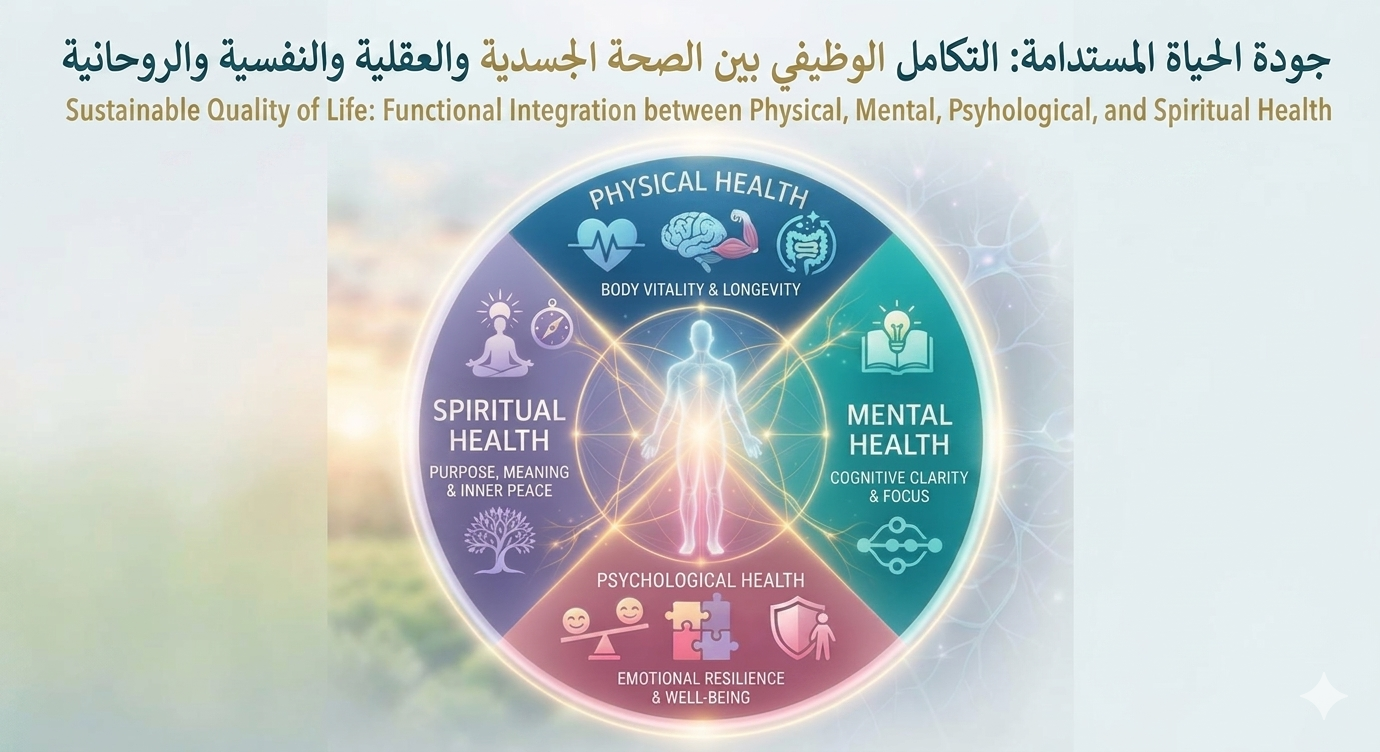
Quality of life cannot be understood by segmenting the human being into isolated parts. Modern medicine is rediscovering what ancient medical philosophies recognized: the human being is an integrated network of energy and information. The four dimensions of health operate like interconnected gears in a precise mechanical watch:
- Physical Health: The physical hardware (the hormonal, nervous, and immune systems).
- Psychic Health: Emotional regulation (feelings, adaptation, resilience, and stress management).
- Mental Health: The processing software (logic, focus, decision-making, and memory).
- Spiritual Health: The existential compass (meaning, purpose, connection to the transcendent, and inner peace).
Chapter II: The Functional Integration Network and Cross-Influence Mechanisms
   ┌────────────────────────────────────────────────────────┐
   │             Spiritual Dimension (Meaning & Purpose)    │
   └───────────────────────────┬────────────────────────────┘
                               │ (Guides motives & grants peace)
                               ▼
   ┌────────────────────────────────────────────────────────┐
   │               Mental Dimension (Thoughts & Logic)       │
   └───────────────────────────┬────────────────────────────┘
                               │ (Shapes perception & cognitive appraisal)
                               ▼
   ┌────────────────────────────────────────────────────────┐
   │          Psychological Dimension (Feelings & Mood)     │
   └───────────────────────────┬────────────────────────────┘
                               │ (Translates emotions via neural axes)
                               ▼
   ┌────────────────────────────────────────────────────────┐
   │            Physical Dimension (Immunity & Organs)      │
   └────────────────────────────────────────────────────────┘
1. The Psycho-Neuro-Endocrine-Immune Axis: Psychoneuroimmunology
Psychoneuroimmunology (PNI) represents the most prominent scientific breakthrough demonstrating functional integration at a physical level. When the mind perceives a threat or experiences a prolonged psychological disturbance (such as chronic anxiety or unresolved grief), the hypothalamus-pituitary-adrenal (HPA) axis triggers the adrenal glands to flood the body with stress hormones (cortisol and adrenaline).
- The Physical Impact of Psychological and Mental Disturbance: Chronically elevated cortisol suppresses white blood cells (specifically T-cells), weakening immunity and elevating silent, low-grade cellular inflammation. This inflammation serves as the root cause of arterial diseases, cancers, and premature aging.
- The Reverse Impact of Body on Mind and Soul: Suffering from chronic intestinal inflammation or malnutrition impairs the production of serotonin (the happiness neurotransmitter) in the gut. This induces depressive symptoms and reduces mental clarity, proving that physical health materially feeds the psychological and mental dimensions.
2. The Spiritual Dimension: The Invisible Driver of Biological Equilibrium
For a long time, the spiritual dimension was excluded from medical laboratories, but modern research has shifted this narrative. Spirituality here is not restricted to a specific dogma; rather, it is phenomenologically defined as a sense of connection to a force that gives life a purpose transcending the physical self, bringing deep inner peace and existential contentment.
Studies published in the National Library of Medicine (PMC) indicate that individuals possessing a robust spiritual foundation (channeled through prayer, meditation, or voluntary humanitarian work) exhibit higher activity in the parasympathetic nervous system. This system is responsible for calming the body and driving cellular repair. This activity lowers heart rate and blood pressure, accelerating recovery from complex organic illnesses compared to counterparts suffering from “existential vacuum.”
Chapter III: Deconstructing the Four Dimensions and Their Impact on Longevity
1. Physical Health (The Sustainable Material Foundation)
Physical health forms the material vessel through which all other dimensions manifest. Physical sustainability is built upon three pillars:
- Conscious Cellular Nutrition: Moving away from destructive consumption patterns and ultra-processed foods while embracing antioxidants and whole foods that support the diversity of the “gut microbiome.” Scientists now refer to this microbiome as the “second brain” due to its direct role in synthesizing mood and mental clarity.
- Continuous Functional Movement: Exercise is not merely for muscle building, but for stimulating the secretion of Brain-Derived Neurotrophic Factor (BDNF). This protein is responsible for generating new neurons in the hippocampus (the brain’s center for memory and learning), directly linking the body to the mind.
- Deep Restorative Sleep: This serves as the brain’s “glymphatic clearance” process, flushing out metabolic waste (such as beta-amyloid proteins linked to Alzheimer’s) and resetting the factory settings of vital regulatory hormones.
2. Mental Health (Cognitive Processing and Neuroplasticity)
Mental health goes beyond the absence of psychiatric disorders to encompass the mind’s ability to process information efficiently and maintain cognitive flexibility:
- Managing Information Influx: In an era of “digital pollution” and constant notifications, a sustainable quality of life requires regulating information consumption and protecting collective attention spans from fragmentation.
- Continuous Learning and Cognitive Stimulation: Building a “cognitive reserve” protects the brain from aging and cognitive decline. This is achieved through reading, problem-solving, and learning new skills or languages throughout life.
3. Psychological Health (Emotional Resilience and Positive Adaptation)
Psychological health centers on the capacity to experience the full spectrum of human emotions (including sadness and anger) without allowing them to crystallize into chronic disorders, thereby developing “psychological resilience”:
- Conscious Emotional Regulation: The ability to observe emotions without harsh self-judgment, utilizing healthy expression techniques such as journaling or positive self-talk.
- Deep Social Bonds: Healthy, supportive social relationships are the strongest predictor of a long, healthy life, as demonstrated by the famous 85-year Harvard Study of Adult Development. The social network operates as a buffer that absorbs psychological shocks and daily stressors.
4. Spiritual Health (The Existential Anchor and Sense of Connection)
Spirituality represents the baseline infrastructure for both the mind and the psychological state. Without clear answers to questions of meaning and purpose, an individual falls into the trap of “nihilism and psychological alienation”:
- Sense of Purpose in Life: Individuals who feel their lives have meaning display astonishing resilience when facing disasters and chronic physical illnesses.
- Mindfulness and Tranquility Practices: Prayer, meditation, and connecting with nature reduce activity in the brain’s “Default Mode Network” (DMN). This network is responsible for negative rumination and future-oriented anxiety, thereby granting the individual sustainable inner peace.
Chapter IV: Pathological Outcomes of the Absence of Integration (Cascade Failure)
When an individual lives in an environment or lifestyle that isolates these dimensions, sequential failure syndromes emerge. A vivid example illustrates how spiritual and psychological void translates into complete physical and mental destruction:
[Spiritual Vacuum & Loss of Purpose]
       │
       ▼
[Anxiety, Psychological Alienation, & Hidden Depression]
       │
       ▼
[Chronic Cortisol Release, Mental Fog, & Impaired Focus]
       │
       ▼
[Compensatory Consumption: Screen Addiction, Fast Food, Nicotine]
       │
       ▼
[Organic Disease: Morbid Obesity, Type 2 Diabetes, Weakened Immunity]
This sequence proves that treating diabetes or obesity (the physical dimension) with medication alone, while ignoring existential vacuum (the spiritual dimension) or chronic anxiety (the psychological dimension), is a temporary band-aid for symptoms rather than a radical cure for the disease. This explains why millions of patients worldwide experience chronic relapses.
Chapter V: Developmental and Economic Returns of Investing in Integrated Health
Embracing a functional integration model of health does not merely serve individuals; it represents a strategic pillar for building sustainable societies and robust economies.
1. Massive Fiscal Savings in Healthcare Budgets
Chronic illnesses and mental health disorders drain the largest share of public health budgets globally. Investing in integrated quality of life programs (such as expanding community meditation spaces, active public parks, and cellular nutrition literacy) reduces the influx of patients into curative hospitals.
Analytical reports by the World Health Organization (WHO) confirm that every dollar invested in primary prevention and the promotion of mental and psychological health returns up to four times its value to the economy in increased productivity, resulting from lowered spending on complex medical treatments and imported pharmaceuticals.
2. Building Creative Human Capital and Sustainable Productivity
In modern knowledge economies, a strong physical body alone is no longer sufficient for production. Creativity, innovation, and complex decision-making require a clear mind (mental health), emotional stability (psychological health), and an internal passion stemming from purpose (spiritual health). Corporations and societies that apply sustainable quality of life concepts witness:
- A sharp drop in occupational burnout.
- A reduction in short-term and long-term medical absenteeism.
- An increase in organizational loyalty and collective innovative capacity.
Chapter VI: Comprehensive Protocols and Strategic Roadmap
To transform these theoretical concepts into a lived reality, this study proposes a practical framework divided into individual and macro-level interventions.
1. Individual Level: The Daily Preventive Protocols
To balance their “vital portfolio” daily, individuals should practice the following targeted actions across the four dimensions:
- The Physical Dimension Actions:
- Dedicate 30 minutes to functional movement daily (such as brisk walking or cardio exercise) to activate blood circulation and trigger the secretion of BDNF.
- Adopt a clean nutrition plan rich in whole grains, fiber, and complete hydration to nourish the gut microbiome for optimal neurotransmitter production.
- The Mental Dimension Actions:
- Allocate 20 minutes to deep reading or learning a new skill to protect neural plasticity and prevent cognitive decline.
- Practice a regular “digital detox” by limiting screen time before bed to prevent attention fragmentation and dopamine overstimulation.
- The Psychological Dimension Actions:
- Maintain a daily gratitude journal to retrain the amygdala to focus on positive parameters.
- Connect meaningfully with a supportive friend or partner to stimulate the release of oxytocin, the hormone of bonding and security.
- The Spiritual Dimension Actions:
- Engage in mindful prayer or silent meditation to minimize the overactivity of the brain’s Default Mode Network (DMN), clearing future-oriented anxiety.
- Practice deep diaphragmatic breathing (such as the 4-7-8 technique) to activate the vagus nerve, which directly lowers cortisol and adrenaline.
2. Macro Level: Community and Governmental Policies
Individual responsibility must be supported by a structural environment. Policy makers should implement the following systemic initiatives:
- Biophilic Urban Engineering: Redesign cities to integrate vast green spaces, urban forests, and protected pedestrian paths. Interacting with nature serves as a free psychological and spiritual therapy that lowers community stress and crime rates while encouraging spontaneous physical activity.
- Workplace Reform and Occupational Well-being Legislation: Mandate flexible working hours, legally safeguard the “right to disconnect” (banning digital work communication after office hours), provide dedicated relaxation or meditation rooms within corporate spaces, and offer free, confidential counseling to shield employees from burnout.
- Embedding Whole Health in Education System: Shift school curricula from pure academic rote learning to teaching life-balancing skills early on. This includes emotional intelligence, cellular nutrition habits, mindfulness practices, and guiding youth to discover their personal passion and purpose.
Chapter VII: Barriers to Health Sustainability and Mitigation Strategies
Unregulated consumer capitalism stands as the greatest barrier to achieving this functional integration. It thrives on fragmenting human attention, fueling psychological anxiety to drive sales, and alienating individuals from their bodies and souls to turn them into cogs in a production-consumption machine.
1. Obstacles to Achieving Comprehensive Well-being
- The Culture of Instant Gratification: Modern humans are conditioned for instant hits of pleasure via a button press (fast food, algorithmic scrolling, video games). This weakens the ability to commit to practices that require time to yield results, such as physical training, meditation, or reading.
- The Commercialization of Well-being: Transforming health and spirituality into high-priced “luxury goods” (expensive gym memberships, overpriced organic branding, costly meditation courses) effectively bars low-income demographics from accessing well-being.
2. Mechanisms of Conscious Resistance (Self-Sovereignty)
To counter these barriers, societies must promote a culture of conscious “minimalism” and cultivate self-sovereignty over attention:
- Cultivate public awareness that the essential tools of functional health integration (walking, prayer, intermittent fasting, consuming simple local ingredients, early sleep) are entirely free and accessible to every human being, requiring willpower and repetition rather than financial capital.
- Form micro-communities that share these values and offer mutual moral support to resist the sweeping tide of digital and consumerist overstimulation.
Conclusion and Recommendations
This deep analytical study demonstrates that a sustainable quality of life is not an intellectual luxury or an optional add-on, but the inevitable outcome of functional integration and harmony among physical, mental, psychological, and spiritual health. Any attempt to repair one dimension while neglecting the others is bound to fail over the long term. A broken body breaks the psyche; a scattered mind deprives the body of equilibrium; a disturbed psychological state secretes hormonal toxins that disrupt cells; and a soul empty of meaning leaves the entire system without a compass in the face of life’s crises.
Based on these extensive findings, the study advances the following strategic recommendations:
- Transition to an Integrative Care Model: Hospitals and medical facilities should treat chronic patients not only with organic medicine but also through mandatory psychological support, mental clarity sessions, and existential guidance as part of the accredited healing protocol.
- Establish a National Holistic Quality of Life Index: Governments should measure national success not merely by Gross Domestic Product (GDP), but by the levels of psychological peace, spiritual alignment, mental clarity, and physical health of their citizens.
- Launch National Human Cybernetic Awareness Campaigns: Educate the public on the precise biological links between thoughts, emotions, spiritual purpose, and cellular health, empowering every individual to become the guardian of their own life sustainability.
The future of humanity does not lie in more complex machinery or genetic treatments, but in a return to the profound, authentic harmony with the four-dimensional human fitra, where a strong body meets an enlightened mind, and a tranquil soul rests in a purpose-driven existence.
Dr. ABDULRAZZAQ HASHIM ALOUJAILI


 English
  العربية