Dr. Abdulrazzaq Hashem Al-Oujaili
Introduction
Amid the growing challenges facing planet Earth in the twenty-first century—accelerating population growth, severe climate change, and scarcity of water resources and fertile agricultural land—humanity finds itself in a race against time to find alternative and sustainable food sources. Among these solutions, Spirulina stands out as one of the most fascinating living organisms. Spirulina is not merely a plant or a passing algae; it is a microscopic living organism belonging to the family of cyanobacteria (blue-green bacteria). Spirulina combines the characteristics of bacteria with the plant-like capacity for photosynthesis. For decades it was known as “blue-green algae,” and it possesses a history stretching back billions of years.
In the modern era, Spirulina has transformed from a primitive food consumed by isolated tribes into a “superfood” topping the best-selling lists of dietary supplements worldwide. It hasn’t stopped there—it has also become the focus of international space agencies and environmental research centers as one of the most important pillars humanity’s future will rely on, whether for securing food on Earth or ensuring human survival in outer space. This research presents an in-depth and detailed study of Spirulina’s life story, tracing its historical path since the formation of the Earth, analyzing its chemical and biological composition in the present, and exploring its pivotal role in shaping the future of food security, bioenergy, and environmental sustainability.
Chapter One: The Nature of Spirulina, Scientific and Biological Classification
1. Definition and Biological Classification
Spirulina is a photosynthetic filamentous bacterium, classified under the order Oscillatoriales. Historically, scientists classified it among algae because of its high capacity for photosynthesis and oxygen production, but modern microscopic examinations and genetic analyses have proven that it belongs to the primitive kingdoms (bacteria), specifically cyanobacteria (blue-green bacteria). The most prominent species cultivated and used commercially and medically are:
- Arthrospira platensis: widespread in Africa, Asia, and South America.
- Arthrospira maxima: concentrated more heavily in Central America, particularly Mexico.
2. Microscopic Structure and Physical Characteristics
Spirulina is distinguished by its coiled, spiral shape (hence the name “Spirulina,” derived from the Latin word meaning spiral). It lives in warm, alkaline waters with high salinity, and grows at temperatures ranging between 35 and 40 degrees Celsius. Spirulina cells lack a rigid cell wall (like the cellulose found in plants); instead they are surrounded by a thin cell wall made of mucous peptidoglycan. This unique biological feature makes Spirulina highly digestible in the human and animal intestines compared to other algae such as chlorella, which requires complex processing to break down its thick cell wall.
Chapter Two: Spirulina in the Past (Historical and Civilizational Roots)
1. The Beginning of Life on Earth
Cyanobacteria, to which Spirulina belongs, are among the oldest living organisms on Earth, with their appearance dating back approximately 3.5 billion years. These organisms are credited with transforming Earth’s primitive atmosphere from one free of oxygen into one rich in it through photosynthesis, paving the way for the emergence of complex life and the evolution of other living organisms.
2. Food of the “Warriors” in Aztec Civilization
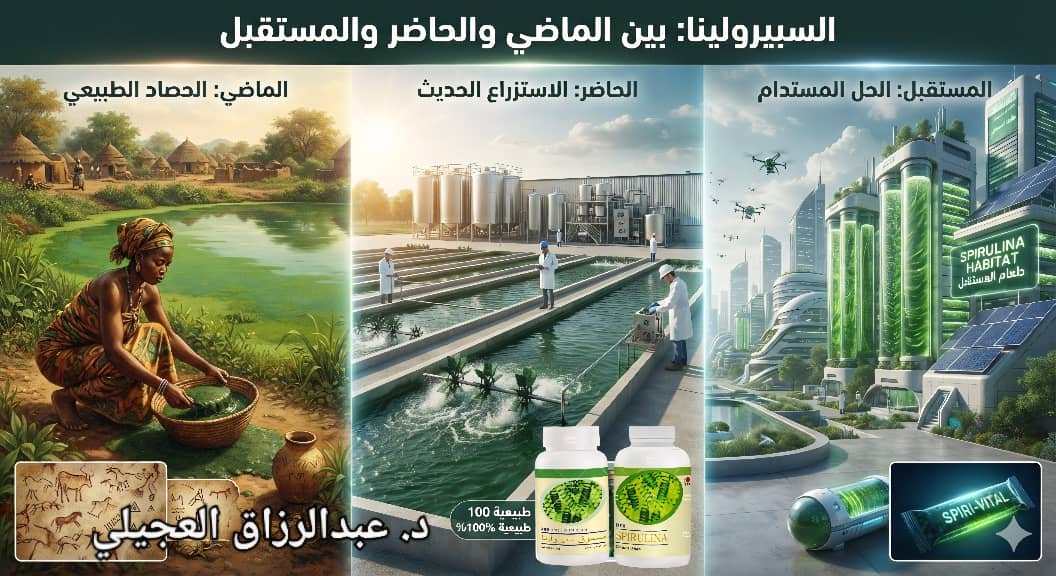
Spirulina was not unfamiliar to ancient human societies. Historical documents left by Spanish conquistadors (such as Hernán Cortés) in the sixteenth century indicate that the Aztec peoples of Mexico extracted a slimy green substance from the surface of Lake Texcoco. The inhabitants called it “Tecuitlatl.” They would dry it under the sun and turn it into blocks or dry bread with a cheese-like flavor. This bread was a primary source of energy and protein for Aztec runners and warriors, giving them exceptional endurance over long distances. This practice gradually disappeared after the lakes dried up due to the urban expansion of Spanish colonizers.
3. The Secret of Survival Among the Kanembu Tribes of Chad
On the other side of the world, on the African continent, the Kanembu tribes settled along the shores of Lake Chad. For many centuries, women would collect the green foam floating on the lake’s surface, filter it using straw baskets, then spread it on hot sand to dry completely. These dried discs are locally known as “Dihé.” They are crushed and mixed with broth, vegetables, and corn. Anthropological and medical expeditions later observed that members of these tribes, despite living in a harsh desert environment suffering from a severe shortage of food resources, did not suffer from malnutrition and enjoyed strong physiques and excellent health compared to neighboring tribes—all credited to their daily consumption of Dihé (Spirulina).
4. Scientific Rediscovery in the Modern Era
In 1964, a French scientific expedition led by botanist Jean Léonard studied Lake Chad and analyzed the Dihé discs. Laboratory results showed that this green substance was none other than Arthrospira platensis algae with extraordinary protein and vitamin value. In 1967, the International Association of Applied Microbiology declared that Spirulina represented “the most important future food source for humanity,” launching thousands of academic and commercial research studies that followed.
Chapter Three: Spirulina in the Present (Nutritional Value and Medical Benefits)
Today, Spirulina holds a prestigious position in the world of preventive medicine and modern nutrition, a position supported by hundreds of clinical studies from trusted bodies such as the World Health Organization (WHO) and national institutes of health.
1. Chemical Analysis and Superfood Composition
Proteins and Amino Acids:
- Record protein content: proteins make up 60% to 70% of Spirulina’s dry weight, a ratio exceeding that of red meat and soybeans.
- Complete protein: it contains all eight essential amino acids that the body cannot synthesize on its own and must obtain from food.
- Exceptional absorption: because it lacks a rigid cellulose cell wall, its proteins are easily digested and absorbed in the intestines at a rate of up to 85%.
Bioactive Pigments and Antioxidants:
- Phycocyanin: the unique blue pigment making up about 15% of its weight, a powerful anti-inflammatory and antioxidant that stimulates blood cell production.
- Chlorophyll: a green pigment that acts as a natural blood purifier, helping expel toxins and heavy metals from the body.
- Beta-carotene: contains high concentrations of beta-carotene (a precursor to vitamin A) that supports eye, skin, and immune health.
Essential Minerals:
- Superior iron: contains 28.5 mg of iron, distinguished by very high bioavailability that exceeds chemical supplements used to treat anemia.
- Copper: contains 6.1 mg, an element necessary to help the body absorb iron and form red blood cells.
- Other diverse minerals: provides balanced doses of calcium, magnesium, zinc, and potassium.
Vitamins and Energy Groups:
- Vitamin B2 (riboflavin): contains 3.6 mg, supporting cell growth, energy production, and eye health.
- Vitamin B1 (thiamine): contains 2.4 mg, essential for metabolic processes and nervous system health.
- Vitamin B3 (niacin): contains 12.8 mg, helping improve cholesterol levels and brain function.
Healthy Fats and Carbohydrates:
- Gamma-linolenic acid (GLA): a rare unsaturated omega-6 fatty acid that strongly helps reduce chronic inflammation and support joint health.
- Complex, slow-release sugars: carbohydrates make up 15% to 20% of Spirulina in the form of complex sugars (such as rhamnose and glycogen) that provide sustained energy without a sudden spike in blood sugar.
2. Scientifically Proven Medical and Therapeutic Benefits
A. Boosting the Immune System and Disease Resistance: Spirulina contains phycocyanin, one of the most powerful natural antioxidants. This compound stimulates the production of white blood cells and antibodies, increasing the body’s ability to fight viruses and bacteria. Other pigments such as beta-carotene and chlorophyll also help purify the blood and neutralize free radicals responsible for cellular aging and cancerous transformation.
B. Combating Anemia: Millions worldwide, especially women and children, suffer from iron deficiency. Spirulina is among the richest plant sources of mineral iron. More importantly, the iron in it is bound to compounds that are more easily absorbed by the intestines than iron sulfate found in traditional commercial supplements, without causing side effects such as constipation or stomach upset.
C. Regulating Cholesterol and Blood Pressure: Clinical studies have shown that regular daily doses of Spirulina (ranging from 1 to 8 grams) significantly help lower LDL (“bad”) cholesterol and triglycerides while raising HDL (“good”) cholesterol. It also stimulates the production of nitric oxide (NO), the substance responsible for dilating and relaxing blood vessels, which helps regulate arterial blood pressure.
D. Supporting Type 2 Diabetes Management: Field research suggests Spirulina has blood-sugar-lowering properties. In some trials, Spirulina outperformed certain well-known diabetes medications when measuring HbA1c levels, helping increase cell sensitivity to insulin and regulate glucose consumption.
E. Expelling Toxins and Heavy Metals from the Body: Bodies are daily exposed to environmental toxins through water, air, and food, such as arsenic, lead, and mercury. Thanks to its very high chlorophyll content, Spirulina acts as a natural chelating agent that binds to heavy metals and toxins in the bloodstream and helps the body eliminate them effectively through vital organs such as the liver and kidneys.
Chapter Four: Current Challenges and Precautions in Spirulina Consumption
Despite its unlimited benefits, using this algae today faces some critical challenges that must be taken into consideration:
1. Contamination with Algal Toxins (Microcystins): Since Spirulina grows in aquatic environments, cultivating it in open, unmonitored settings can lead to contamination with other types of toxic cyanobacteria that produce liver toxins known as “microcystins.” These toxins can cause severe liver and kidney damage if consumed over long periods. Therefore, it is essential to purchase Spirulina from trusted companies holding international quality certifications (such as USDA Organic or GMP certification).
2. Heavy Metal Absorption: Spirulina is inherently an absorbent organism. If grown in water contaminated with industrial waste or pesticides, it will absorb lead, arsenic, and mercury at high concentrations, turning it from a healthy supplement into a dangerous toxic substance.
3. Groups That Should Consult a Doctor Before Use (or start with very small trial amounts to test how their body responds):
- PKU (phenylketonuria) patients: because Spirulina is rich in the amino acid phenylalanine, which these patients’ bodies cannot metabolize.
- Patients with autoimmune diseases (such as lupus, multiple sclerosis, and rheumatoid arthritis): because Spirulina strongly stimulates the immune system, which may increase the body’s attack on itself and worsen symptoms.
- People taking blood thinners (such as warfarin): since Spirulina contains vitamin K, which aids clotting and may interfere with the medication’s effect.
- Kidney disease (kidney failure) patients: due to its high protein content.
Chapter Five: Spirulina in the Future (Sustainability and Food Security Prospects)
If the past knew Spirulina as a primitive food, and the present has established it as a health supplement, the future opens its arms for this algae to become a key player in preserving human civilization and solving its greatest environmental and economic problems.
1. A Cornerstone of Global Food Security: Traditional agriculture and animal meat production are reaching a dead end due to their enormous resource consumption. Producing one kilogram of animal protein (beef, for example) requires thousands of liters of water and vast areas of grazing land, while emitting huge amounts of methane gas that contributes to global warming. In contrast, Spirulina offers incomparable production efficiency:
- Water savings: Spirulina requires about 10 to 50 times less water to produce the same amount of protein compared to livestock.
- Land use: it can be grown in plastic or glass ponds on arid land, salt flats, or building rooftops, without needing to destroy forests or exploit fertile soil.
- Growth speed: its biomass doubles within just 24 to 48 hours and can be harvested year-round, making it far faster than field crops like wheat and soybeans.
Consequently, many international humanitarian organizations today run projects to spread Spirulina cultivation ponds in developing countries and Africa as a key strategic tool to combat child famine and chronic severe malnutrition.
2. Food for Astronauts and Mars Colonization: When discussing deep space travel or building permanent human colonies on the Moon or Mars, securing food and oxygen emerges as one of the biggest obstacles. Spacecraft cannot carry tons of dried food for journeys lasting years. For this reason, NASA and the European Space Agency (ESA) have for many years been incorporating Spirulina into closed-loop life support system projects, most notably the MELiSSA project (Micro-Ecological Life Support System Alternative). Spirulina is considered the ideal candidate for space travel for the following reasons:
- Dual-benefit system: astronauts consume Spirulina as a fresh, complete food source, while at the same time the algae absorbs the carbon dioxide exhaled by astronauts and converts it through photosynthesis into pure, breathable oxygen inside the spacecraft.
- Waste recycling: research is exploring the possibility of using some treated organic waste as nutrients for space-based Spirulina tanks, creating a completely closed and self-sufficient ecological cycle.
3. Combating Climate Change and Carbon Capture: Spirulina can absorb carbon dioxide (CO₂) from the atmosphere far more effectively than trees. Modern photobioreactors using Spirulina absorb greenhouse gases directly from industrial facilities and power plants, converting them into useful green biomass, directly contributing to reducing global warming and cooling the planet.
4. The Coming Revolution in the Biofuel Sector: With the inevitable depletion of fossil fuels (oil and gas) and the environmental damage they cause, attention is turning toward third-generation biofuels derived from algae and cyanobacteria. Spirulina contains carbohydrate and lipid compounds that can be extracted and chemically processed through fermentation or thermal cracking to produce:
- Biodiesel: carbon-neutral fuel that can power trucks and aircraft engines without complex modifications.
- Bioethanol and methane: for use in electricity generation.
Although the economic cost of producing biofuel from Spirulina remains high compared to conventional oil, advances in genetic engineering and automated harvesting technologies promise to reduce costs and make it a strong commercial competitor within the coming decades.
Chapter Six: Biotechnology and the Future of Genetically Modified Spirulina
Biotechnology is playing an increasingly powerful role in modifying and developing Spirulina’s characteristics to meet the complex needs of the future. Using gene-editing techniques such as CRISPR-Cas9, scientists in advanced laboratories are currently working on:
- Increasing frost and cold resistance: to enable Spirulina to grow in cold countries during winter without needing to artificially heat the ponds, saving enormous amounts of energy.
- Biofactories for drug production (bio-pharmaceuticals): modifying Spirulina’s genes so it can produce complex therapeutic proteins, such as human insulin, monoclonal antibodies, and oral vaccines. This innovation could one day allow biopharmaceuticals to be produced very cheaply and made accessible to poor countries simply by consuming fresh algae.
- Improving flavor and smell: some consumers currently complain about Spirulina’s seaweed- or fish-like smell and strong flavor. Food startups are working to develop “odorless and tasteless” algae strains to easily incorporate into baked goods, juices, and plant-based meat alternatives without altering their original taste.
Recommendations for Anyone Wishing to Use Spirulina and Gain Its Benefits
The following recommendations are provided for every user to achieve maximum benefit (based on dozens of established scientific studies):
1. Gradual Increase in Daily Amount:
- Start small: consume 1 to 1.5 grams daily (half a teaspoon or one tablet) during the first week.
- Gradual increase: raise the amount gradually until reaching the standard dose of 3 to 5 grams daily.
- Maximum for athletes or those with mineral/vitamin deficiencies: athletes, those engaged in strenuous effort, or people with severe mineral and vitamin deficiencies may raise the amount to 8 to 10 grams daily once the body has adjusted.
- Drinking plenty of water is essential.
- Treat Spirulina as a food, not a medicine.
- Consistency is the secret to benefit and achieving health goals.
2. Optimal Timing for Consumption:
- For increased energy and activity: take it in the early morning with breakfast or half an hour before exercise.
- To help with weight loss: take it an hour before main meals with a large glass of water to enhance the feeling of fullness.
- To improve digestion: take it during or immediately after meals to facilitate the absorption of minerals and vitamins from food.
3. Creative Ways to Incorporate It into Your Diet:
- Blending into smoothies: mix Spirulina powder with mango, pineapple, or banana and milk juices to soften its herbal flavor.
- With lemon or citrus: adding a few drops of lemon or orange juice enhances the absorption of Spirulina’s iron thanks to vitamin C.
- Avoiding high heat: do not mix the powder into hot soups, tea, or coffee, since high heat destroys vitamins and antioxidants (such as phycocyanin).
4. Criteria for Choosing a Safe and Pure Product:
- Organic certifications: buy products bearing international quality seals such as USDA Organic or European organic certification and other trusted sources.
- Check the origin: make sure the Spirulina is cultivated in controlled environments protected from environmental pollution and heavy metals.
- Product form: choose tablets if you don’t like the seaweed taste, or powder if you want to blend it into juices and cold foods.
Conclusion
Studying Spirulina’s journey between past, present, and future reveals an extraordinary biological resilience and a unique capacity for adaptation and vital service to planet Earth and its inhabitants. This primitive microorganism, which accompanied the formation of the Earth, nourished the ancient Aztec empires, and protected the tribes of Chad from extinction, is the same organism that today stands tall in pharmacies as one of the most powerful dietary supplements, and in space laboratories as the sole hope for reaching other planets.
Investing in Spirulina is no longer merely a scientific luxury or a passing trade in the supplements sector—it is a strategic investment in the future of human survival. The shift from traditional, polluting, resource-consuming agricultural and industrial systems toward circular biological systems based on algae and cyanobacteria represents the optimal solution to the equation of food security, clean energy, and environmental balance. To achieve maximum future benefit from Spirulina, governments and research institutions must intensify financial support for developing cultivation technologies and establish strict regulatory standards to ensure purity, quality, and freedom from toxins—so that Spirulina remains forever what it always was: “green gold,” pulsing with life and healing across the ages.
Dr. Abdulrazzaq Hashem Al-Oujaili


 English
  العربية
مقال أكثر من رائع .. معلومات واسعة ودقيقة .. أنا أتناول السبيرولينا منذ عدة سنوات وقد منحتني الصحة والنشاط والمناعة المتوازنة والشباب والحيوية.
جزيل الشكر للدكتور عبد الرزاق على هذا البحث الشامل عن السبيرولينا (الذهب الأخضر) .
مقال أكثر من رائع .. ألقى الضوء على أعظم غذاء على وجه الأرض 🌟 .. منذ سنوات وأنا أتناول السبيرولينا وقد منحتني الصحة والنشاط والحيوية .
جزيل الشكر للدكتور عبد الرزاق على هذا البحث الرائع